
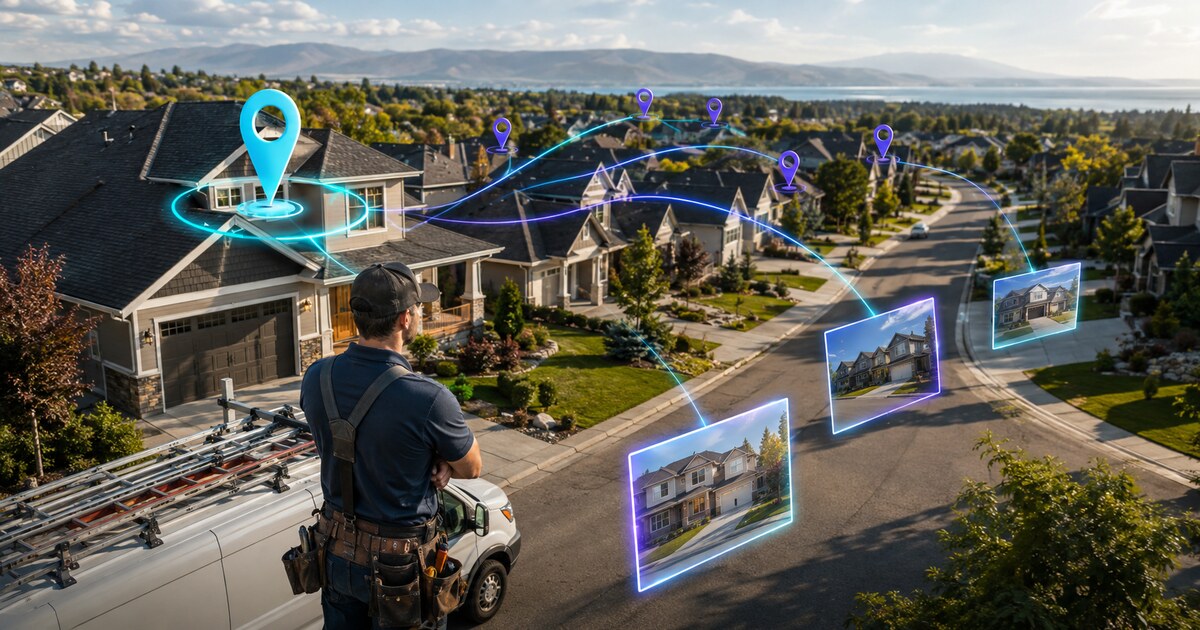
One of the most valuable things we hear from contractors who've been in business for a while is also one of the most underused strategies by contractors who are newer: the neighborhood compound effect.
When you complete a job in a neighborhood, three things are true simultaneously. Your customer's neighbors saw your truck. They may have noticed the before or after of whatever you did. And they're now in a neighborhood where they know a contractor has just done work — which means if they have the same need, they're primed to act on it.
Most contractors do nothing with this. The job finishes, the truck leaves, and the natural marketing momentum of having just worked on that street dissipates entirely. What you could have turned into three more calls becomes nothing at all.
Why the neighborhood is your best next customer
Homes in the same neighborhood tend to be the same age, built with similar materials, and exposed to the same weather patterns and local conditions. If one house on a street needs new siding, chances are good that several nearby houses need it too — or will soon. If one HVAC system is aging out, the others from the same installation era probably are as well.
Neighborhood proximity also functions as a trust signal. A homeowner who sees that their neighbor hired you — and the work looks good — has already received a warm referral before you've said a word. You're not a stranger making a cold pitch. You're the contractor who just did that house down the block.
The two barriers that prevent most contractors from capitalizing on this: they don't make their presence visible while they're working there, and they don't have any system to reach the surrounding homes after the job is done.
Making your presence visible while you're there
The basics matter more than contractors usually give them credit for:
A branded truck in a visible spot
Your vehicle is a mobile advertisement. Park it in the most visible spot on the street — ideally in front of the house, not tucked in the driveway. If your truck isn't branded with your business name, phone number, and trade, the opportunity to generate passive impressions while you work is entirely gone.
A yard sign during and after the job
Yard signs are low-cost and surprisingly effective for contractor neighborhood marketing. "Work in progress by [Your Business Name] — [phone number]" during the job, and "This home's [service] done by [Business Name]" for a week or two after (with the homeowner's permission) extends your visibility past the day you're actually there.
A professional and visible crew
Branded shirts or jackets create the impression of an established, professional operation — not someone working out of a personal truck. Neighbors notice. If the work looks careful and the crew looks professional, the impression carries.
Direct mail: the underrated tool that still works
Direct mail to the homes surrounding a completed job is one of the most effective and least-used contractor marketing tactics. The reasons it works are exactly the reasons it feels counterintuitive to digital-native marketers: it's physical, it's local, and it arrives in a context where it's immediately relevant.
The message writes itself: "We just completed [type of work] for your neighbor at [general location]. We're in your area regularly and we'd be happy to take a look at your [service need] while we're nearby. Call us at [phone] or visit [website]."
The targeting is simple: the 50–200 homes closest to the job you just finished. These are the people most likely to have the same need, to trust you because of the social proof of your existing customer, and to respond because the timing is immediately relevant.
TradeZIP's Print the Street feature makes this systematic: enter the job address, choose a radius, and professionally designed postcards go to the surrounding homes. No list management, no printing coordination, no trips to the post office. The job finishes, the campaign goes out.
The digital layer that amplifies your physical presence
Physical visibility and direct mail reach the neighbors who were paying attention. Digital channels reach the ones who weren't there but are searching now.
Photos from the job on Google Business Profile
Photos tagged to a location (your GBP photos inherit your service area) contribute to your local relevance for searches in that neighborhood. A regular cadence of job photos — posted to your GBP after each completed job — builds a visual portfolio that shows up in local search results. See our guide on GBP optimization for the specifics of how photo posting works.
Neighborhood-specific content
If you've completed several jobs in a specific neighborhood or subdivision, a piece of content specifically about that area — "common [trade] issues in [neighborhood name] homes" — can rank for neighborhood-specific searches and attract homeowners in that exact area. This is an extension of the local SEO strategy that uses service-area pages, but applied at a neighborhood level.
Nextdoor
Nextdoor is a neighborhood-level social network where homeowners actively discuss and recommend local service businesses. If your customer posts about your work, it reaches their exact neighbors — the highest-relevance audience you could ask for. You can also maintain a Nextdoor Business page, respond to service recommendations in areas where you work, and participate appropriately in neighborhood conversations about your trade.
Print the Street — included in every TradeZIP plan
After every job, send professionally designed postcards to the surrounding homes. Enter the address, choose your offer, and we print and mail. Campaign pricing starts at $59 for 50 homes.
See Print the Street pricing →Customer follow-up that generates referrals
Your existing customers are the best source of neighborhood referrals — but only if you make it easy and give them a reason.
Ask for a review immediately after the job
A Google review from a customer often mentions the neighborhood or the type of home they have — both of which help you rank for searches in that area. And when their neighbors see it while evaluating contractors, they'll recognize the address or context. See our complete guide on getting more Google reviews for the approach that consistently works.
A referral offer worth mentioning
Many contractors have a referral program in theory — "tell your friends." Few have one that's specific enough to actually motivate referrals. A concrete offer ("refer a neighbor and get $50 off your next service call") is something a customer can actually communicate. "Tell your friends" isn't.
Seasonal follow-up
A brief, personal follow-up to past customers at the start of relevant seasons — "Hey, just wanted to check in as we're heading into spring. If you know any neighbors who need [service], we'd appreciate the referral" — generates a surprising number of responses. It's not aggressive, it's timely, and it puts you top of mind at exactly the moment they're most likely to know someone with a need.
Making it a repeatable system
The contractors who consistently generate neighborhood work from each job don't do it through individual effort — they've made it a system that happens automatically as part of their job completion process.
The components of that system:
- Branded vehicle parked visibly at every job
- Yard sign during and for 1–2 weeks after major jobs
- Review request sent to the customer within an hour of leaving
- Direct mail campaign sent to surrounding homes within a week of job completion
- Job photos posted to GBP within 48 hours
- Seasonal follow-up to past customers in high-demand periods
None of these individually are time-consuming. Together, as a consistent practice, they create a compounding effect where each job generates visibility that leads to the next one — reducing your dependence on paid lead platforms and building a reputation in specific neighborhoods that compounds over time.
Key takeaways
- Neighbors are your highest-quality next customers — same housing stock, social proof already established, primed by seeing your truck and work.
- Make your presence physically visible: branded vehicle, yard signs, professional-looking crew.
- Direct mail to surrounding homes is underused and effective — the message is immediately relevant and the audience is perfectly targeted.
- Digital amplification (GBP photos, Nextdoor, neighborhood-specific content) reaches neighbors who weren't watching but are searching now.
- Reviews from neighborhood customers build local search relevance for that area over time.
- Make all of this a repeatable system, not an occasional effort. The compound effect shows up over months, not days.
Related reading
Turn every finished job into your next one
TradeZIP's Print the Street is included in every plan — complete a job, send postcards to the surrounding homes, and keep the neighborhood working for you.
Get started →