
One of the first things I do when I start working with a new contractor is look at their website and ask: do you have a page specifically for each city you serve?
The answer is almost always no. And that one gap — more than anything else on their site — explains why their phone isn't ringing the way it should.
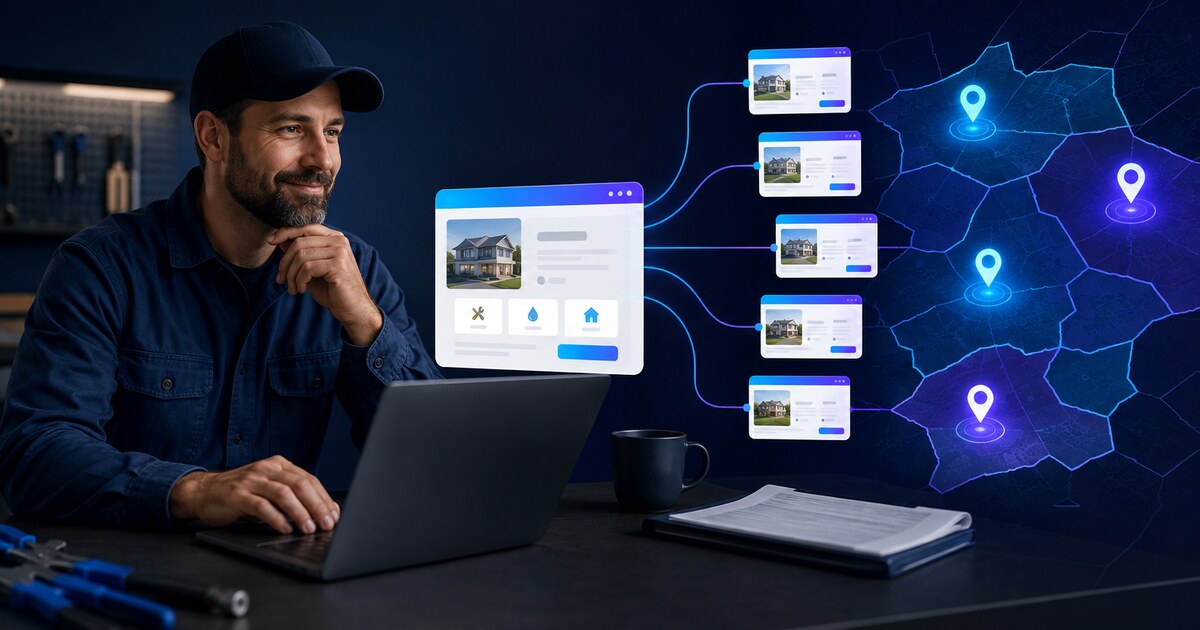
Service-area pages are dedicated pages on your website, one per city or service area, that tell Google (and homeowners) exactly what services you offer in that location. They're the mechanism that lets a plumber in Denver rank in Aurora, Broomfield, and Arvada at the same time — without any paid advertising.
What service-area pages are
A service-area page is a standalone page on your contractor website dedicated to one specific geographic area you serve. If you're a painter who works in Louisville, Lafayette, and Superior, you'd have a separate page for each — not a homepage that mentions all three in one paragraph.
The URL structure is simple: /painter-louisville-co/ or /service-areas/louisville/. The content is specific to that location: what painting services you offer there, why homeowners in that area hire you, any relevant context about the types of homes or commercial properties in that city.
Think of it as a local landing page. It's not just a repeat of your homepage with a different city name — it's a page that could genuinely help a homeowner in that specific area understand what working with you looks like.
Why they work for local search
Google's local search algorithm tries to match the searcher's location with businesses that are specifically relevant to that location. A homepage that says "serving the Denver metro area" is relevant to the whole metro area — in theory. In practice, it's relevant to none of it specifically.
When someone in Broomfield searches "concrete contractor Broomfield," Google is looking for signals that indicate your business genuinely serves Broomfield. Those signals include:
- A page on your website with "Broomfield" in the title tag, the H1, and the content
- Your Google Business Profile listing Broomfield as a service area
- Citations and directory listings that mention Broomfield
- Reviews that mention Broomfield jobs
A dedicated service-area page addresses the first signal directly. Combined with the others (especially a well-optimized Google Business Profile), it creates a clear, consistent picture of geographic relevance that generic homepages simply can't match.
For a broader look at how local SEO works and how service-area pages fit into it, see our cornerstone guide on local SEO for contractors.
What makes a service-area page actually work
Not all service-area pages are created equal. The ones that rank and convert have these characteristics:
Unique, specific content
The page needs content that's genuinely useful to someone in that city — not just your homepage text with the city name swapped in three places. Google is adept at recognizing thin, templated content and ranking it accordingly. Write about the specific neighborhoods or subdivisions in that city where you commonly work. Mention the types of projects that come up most often there. Reference any local context that's relevant to your trade.
City name in the right places
Include the city name in the page title tag, the H1 heading, at least one H2, and naturally throughout the body text. Don't force it — write for the homeowner first, and the search engine will follow. A good rule of thumb: if someone from that city read the page, would they recognize it as being specifically about your business in their area?
A clear conversion path
Every service-area page needs a prominent call to action — your phone number (click-to-call on mobile), a quote request form, or both. A page that ranks but doesn't convert is worthless. The conversion path should be impossible to miss.
Internal links from your homepage and other pages
Your service-area pages should be discoverable from your main site. Link to them from your homepage, your main services pages, and your navigation if you have enough areas to warrant a "Service Areas" section.
50 local service-area pages included in every TradeZIP plan
We build and maintain dedicated landing pages for every city and zip code you serve — so you rank in the areas that matter, not just your home base.
See how it works →Common mistakes that make them useless
Duplicate content across pages
The most common mistake: building 20 service-area pages by copying the same template and swapping the city name. Google recognizes this pattern and treats it as thin content. Each page needs genuinely differentiated content. That doesn't mean it needs to be a 2,000-word essay — 400–600 words of useful, location-specific content is better than 1,500 words of templated filler.
No internal linking
Pages that aren't linked from anywhere on your site are almost impossible for Google to find and rank. Your service-area pages need inbound links from other pages on your site — at minimum, from a dedicated "Service Areas" page in your navigation.
Missing NAP information
Every service-area page should include your business name, phone number, and service-area information. This reinforces the local signals that help the page rank. It also makes it easy for homeowners to contact you immediately after reading.
Building pages for areas you don't actually serve
Google cross-references your GBP service area settings, your website's location pages, and signals from reviews and citations. If you build a page for a city that's completely outside your actual service area, it's unlikely to rank — and if it does generate a call, you'll be turning down the job. Build pages for cities where you genuinely work.
How many do you need?
Start with the cities where you most want to grow — typically the highest-value areas adjacent to your home base. A contractor serving a mid-sized metro area might start with 10–15 pages covering their primary service territory, then expand as they grow.
The practical minimum for most metro-area contractors is one page per city you actively serve. If you serve 20 zip codes across 8 cities, you want at least 8 pages — and ideally pages for the specific neighborhoods within those cities where you do the most work.
There's no SEO penalty for having more service-area pages, as long as the content on each one is genuinely useful and differentiated. Thin, duplicate pages, on the other hand, can actually hurt your overall site ranking. Quality beats quantity.
Also worth considering: your website cost calculation changes significantly when you factor in service-area pages. A plan that includes 50 dedicated local pages at a flat monthly rate is often more cost-effective than building and maintaining them separately.
Key takeaways
- Service-area pages are dedicated website pages for each city you serve — the primary mechanism for ranking in multiple locations without paid ads.
- They work because Google rewards location-specific relevance signals that generic homepages can't provide.
- Effective pages have unique content, city-specific context, clear calls to action, and internal links from your main site.
- Duplicate templated content is the most common and damaging mistake — Google recognizes it and discounts the pages.
- Build pages for cities you actually serve. Quality and specificity beat quantity.
Related reading
50 local service-area pages, included from day one
Every TradeZIP plan includes professionally built service-area pages for every city you serve — so you rank in the areas that matter, not just where your office is.
See plans and get started →